


Since its birth in 2013, Ivtec WideGrip – the universal car rack for bicycles has deservedly earned wider positions in the sports accessories market. The perseverance with which we follow the chosen direction and improve our product is the conviction that the WideGrip idea is not only different, but also provides indisputable advantages over the familiar ways of transporting our two-wheeled friends.
How to transport your bike?
With the growing popularity of cycling in all its forms – on the road or in the mountains, in a race or with the family, on a challenging adventure or casual tourism – the ways to transport your bicycles are also multiplying.
If we have to classify them with regard to the position of the bike on the car, there are two main types:
- rear mount (hitch mount or strapped to the car’s trunk);
- roof mount.
The pros and cons of the two ways are of different nature. It is difficult, even impossible to judge unequivocally what position is better.
We are convinced that the concept of Ivtec WideGrip – the inverted bicycle on the roof of the car – combines some of the most prominent advantages of the two traditional types by avoiding or minimizing a number of their disadvantages.
The family of the “rear” bike racks
The ways to attach a bicycle carrier to the back of the car are by a hitch or by straps and hooks. The most intrusive difference between them is the price. The more rigid and faster to install hitch rack comes to a noticeably higher price than its belted brother.
And there is a reason! Fixing a carrier to the trunk of the vehicle with multiple straps takes time and skills, without guaranteeing sufficient safety at higher speeds, sharp maneuvers or rough terrain, and does not provide enough anti-theft protection. The straps can be cut quickly and easily, and the bikes can lose their owner along with the rack.
The relative instability and the inevitable vibrations caused by the direct (but soft) connection between the car and the rack suggest damage to the paint of car. Damage to back door hinges is also not uncommon due to the additional load caused by the bicycle(s), the shaking and the centrifugal forces when turning.
One family, common problems
Despite the undeniable advantages of the hitch racks over the strapped racks, both are from the same family and share many the innate disadvantages. The most immediate is the difficult access to the car trunk, especially once you have loaded your bicycles. Some manufacturers are trying to solve this problem by “moving” the load compartment, but it comes with increased weight and price.
Another functional limitation of “rear” bicycle carriers is that most of them hide or partially hide the rear plate of the vehicle. If you want to avoid being sanctioned, the use of such a carrier requires the issuance of a third registration plate. This procedure often takes a lot of bureaucracy and time.
Also cannot be ignored the hiding of the break lights, which in the eyes of the other drivers makes you more unpredictable, and the risk of the car after you to meet closely with the bicycles is higher.
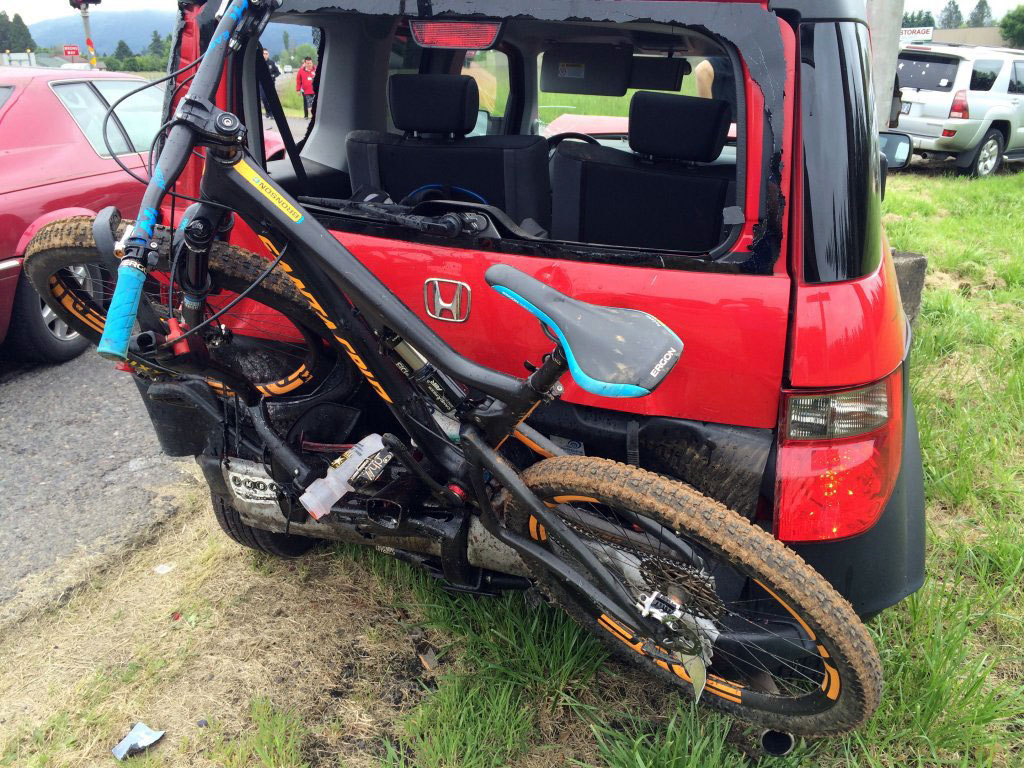
The design of the “rear” racks requires smaller distance between the loaded bicycles. The way they are hanged on the rack (if not of the rail type) also implies swinging. To avoid rubbing or collisions between the bikes, a sufficient amount of soft padding and experience in positioning and fixing them are required. In the end, you waste the time you earned from the quick installation of the carrier itself (with a hitch) to secure the inevitable contact between the loaded bicycles.
We should also not ignore some seemingly petty considerations of the “rear” ride – the contamination of the bikes in rainy, snowy weather, their proximity to the exhaust and hot gases that are thrown out of the car. With the increasing usage of carbon fibre and other more delicate materials in the bicycle industry, the consequences and possible damage to the bikes of these elements can be irreversible.
The classic “roof” racks
Many of the disadvantages listed for the “rear” racks are eliminated when installing bicycles on the roof of the car. But there are other troubles – the need to install load bars, compromised aerodynamics, increased fuel consumption and noise. It will not be pleasant for your bicycle budget if you happen to enter a garage, parking, go under low branches or other low obstacles with the bikes on the roof.
Very often, users complain that loading and fixing a bicycle can be difficult – especially with higher cars. Occasionally, more than one person is required in this process.
Placed on the roof, but upside-down
Ivtec WideGrip shares the benefits of the traditional roof bike racks, but eliminates, or at least minimizes some of the mentioned risks and the inconveniences they cause.
Ivtec WideGrip and the its “inverted” grip allow you to safely fix the bicycle to the rack without the need to hold it all the time. The three-point contact (the two handlebar handles and rear tire or seat) guarantees more stability not only while loading it, but also while driving on any kind of terrain and during unforeseen maneuvers.

The inverted position – where the wider part of the bicycle is closer to the roof of the car, and the tires with its smaller surface area (in the direction of movement), along with its free rotation – provides less drag. Expect the results of our deliberate experiment with different bike racks to determine the difference in fuel consumption between Ivtec WideGrip and its competitors of different types soon. We’ll share them with you – don’t doubt it!
The fixing of bike to the Ivtec WideGrip bike rack is carried out through the so-called “consumables” on the bicycle – the handlebar handles and the tires or the seat. This avoids the risk of contact with the frame, which especially in carbon materials can have fatal consequences. The distance between the three or four bicycles on your car’s roof is not affected by shaking during the journey and is enough to avoid the need of any additional protection against rubbing and collisions.
Even when passing under and unexpected contact with low obstacles, the bicycle placed on an Ivtec WideGrip carrier has a greater chance of passing through unharmed. The contact is first with the tires and the suspension, which, thanks to their shape and function, can soften the impact. The brakes, the handlebar, the frame – the more delicate and expensive parts of the bicycle – remain lower and are at less risk of damage.
Ivtec follows your bike rhythm
Finally, it comes to a key advantage of the inverted Ivtec WideGrip bike rack, especially valid for the most eager and dedicated mountain bikers. The desire to embark on the next unforgettable route as soon as possible often comes at the expense of timely maintenance of important bicycle elements. Ivtec WideGrip and its distinctive inverted position of the bikes during transportation guarantees that your fork is always well lubricated and always ready for adventure.
Just like you.
